

Three Mechanisms for Randomness
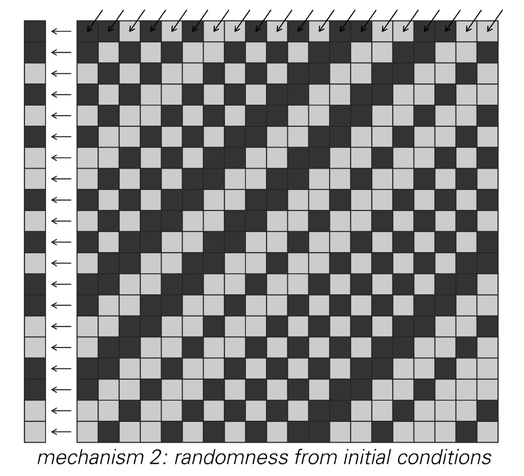
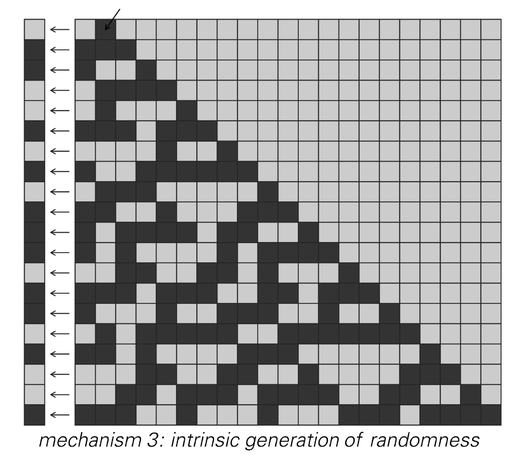
In nature one of the single most common things one sees is apparent randomness. And indeed, there are a great many different kinds of systems that all exhibit randomness. And it could be that in each case the cause of randomness is different. But from my investigations of simple programs I have come to the conclusion that one can in fact identify just three basic mechanisms for randomness, as illustrated in the pictures below.
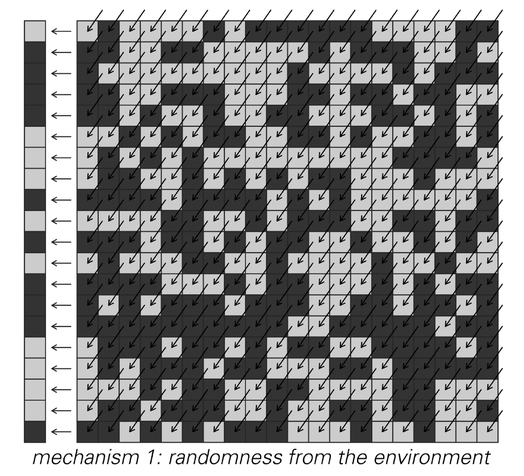 |  |  |
In the first mechanism, randomness is explicitly introduced into the underlying rules for the system, so that a random color is chosen for every cell at each step.
This mechanism is the one most commonly considered in the traditional sciences. It corresponds essentially to assuming that there is a random external environment which continually affects the system one is looking at, and continually injects randomness into it.
In the second mechanism shown above, there is no such interaction with the environment. The initial conditions for the system are chosen randomly, but then the subsequent evolution of the system is assumed to follow definite rules that involve no randomness.