Notes

Chapter 11: The Notion of Computation


Section 1: Computation as a Framework

History of computing Intuition from practical computing Practical computers

Section 2: Computations in Cellular Automata

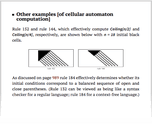
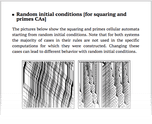
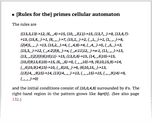
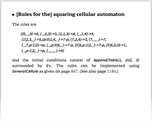
Efficiency of computations [in cellular automata] Minimal [cellular automaton] programs for sequences Other examples [of cellular automaton computation] Random initial conditions [for squaring and primes CAs] [Rules for the] primes cellular automaton [Rules for the] squaring cellular automaton
Section 3: The Phenomenon of Universality

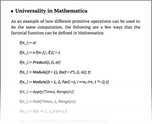
History of universality Universality in Mathematica

Section 4: A Universal Cellular Automaton

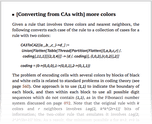
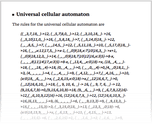
[Converting from CAs with] more colors Universal cellular automaton

Section 5: Emulating Other Systems with Cellular Automata

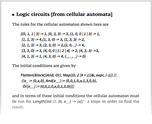
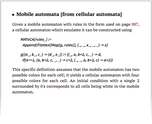
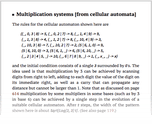
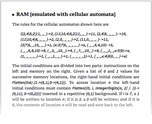
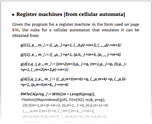
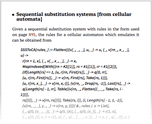
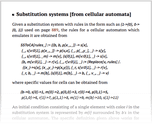
Continuous systems [from cellular automata] Logic circuits [from cellular automata] Mobile automata [from cellular automata] Multiplication systems [from cellular automata] RAM [emulated with cellular automata] Register machines [from cellular automata] Sequential substitution systems [from cellular automata] Substitution systems [from cellular automata] Turing machines [from cellular automata]
Section 6: Emulating Cellular Automata with Other Systems

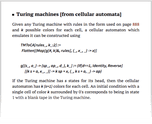
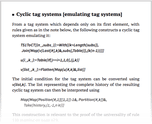
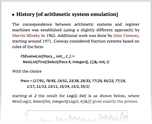
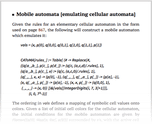
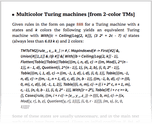
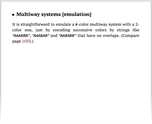
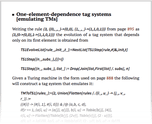
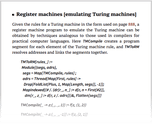
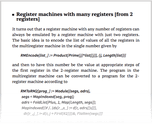
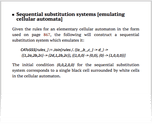
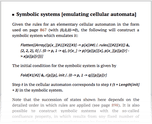
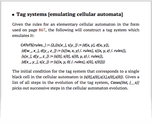
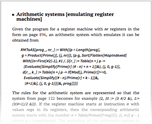
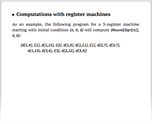
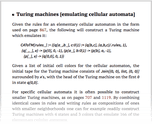
Arithmetic systems [emulating register machines] Computations with register machines Cyclic tag systems [emulating tag systems] History [of arithmetic system emulation] Mobile automata [emulating cellular automata] Multicolor Turing machines [from 2-color TMs] Multiway systems [emulation] One-element-dependence tag systems [emulating TMs] Register machines [emulating Turing machines] Register machines with many registers [from 2 registers] Sequential substitution systems [emulating cellular automata] Symbolic systems [emulating cellular automata] Tag systems [emulating cellular automata] Turing machines [emulating cellular automata]
Section 7: Implications of Universality


Section 8: The Rule 110 Cellular Automaton

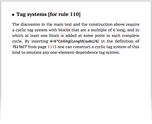
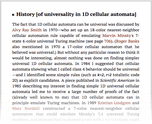
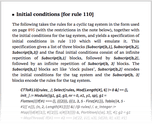
History [of universality in 1D cellular automata] Initial conditions [for rule 110] Tag systems [for rule 110]

Section 9: The Significance of Universality in Rule 110


Section 10: Class 4 Behavior and Universality

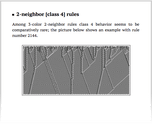
2-neighbor [class 4] rules [Universal] totalistic rules [Universality in] 2D cellular automata

Section 11: The Threshold of Universality in Cellular Automata

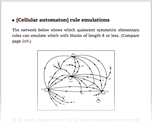
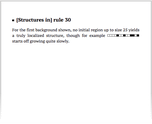
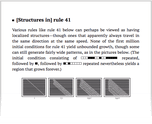
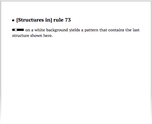
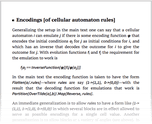
[Cellular automaton] rule emulations Claims of non-universality [in cellular automata] Encodings [of cellular automaton rules] Logic operations and universality [Structures in] rule 30 [Structures in] rule 41 [Structures in] rule 73
Section 12: Universality in Turing Machines and Other Systems

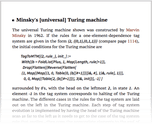
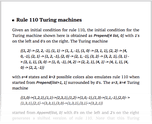
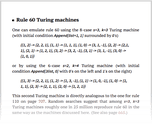
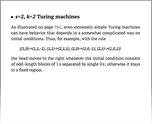
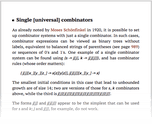
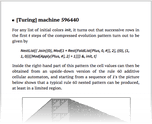
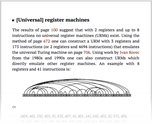
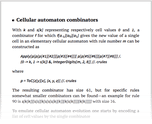
Cellular automaton combinators Combinator properties Combinators Criteria for universality History [of universal Turing machines] Lambda calculus [Methods of] encoding sequences by integers Minsky's [universal] Turing machine Rule 110 Turing machines Rule 60 Turing machines s=2, k=2 Turing machines s=3, k=2 Turing machines Single [universal] combinators States versus colors [in Turing machines] Testing universality [in symbolic systems] [Turing] machine 596440 Turing machine enumeration [Universal] recursive functions [Universal] register machines [Universal] tag systems [Universality for] classes of systems

From Stephen Wolfram: A New Kind of Science [citation]