Notes

Chapter 7: Mechanisms in Programs and Nature


Section 1: Universality of Behavior

History [of universality of behavior]

Section 2: Three Mechanisms for Randomness

Applications of randomness Definition [of randomness] History [of randomness] Sources of randomness

Section 3: Randomness from the Environment

Electronic noise Electronic randomness Mechanical randomness Ocean surfaces Physical randomness generators Power spectra [of random processes] Quantum randomness Random walks Randomness in biology Randomness in computer systems Spark chambers Stochastic models

Section 4: Chaos Theory and Randomness from Initial Conditions

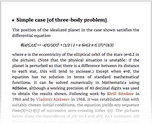
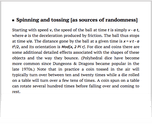
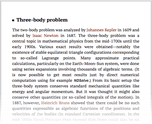
Billiards Fluttering History of chaos theory Information content of initial conditions Instability [and chaos theory] Randomness in the solar system Recognizing chaos Simple case [of three-body problem] Spinning and tossing [as sources of randomness] Three-body problem
Section 5: The Intrinsic Generation of Randomness

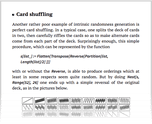
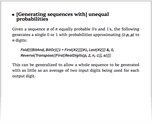
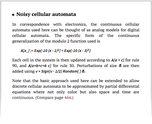
Algorithmic randomness Autoplectic processes Card shuffling Cellular automata [as randomness generators] [Generating sequences with] unequal probabilities Noisy cellular automata Probabilistic rules [for cellular automata] Random number generators Randomness in Mathematica Repeatably random experiments Sources of repeatable randomness
Section 6: The Phenomenon of Continuity

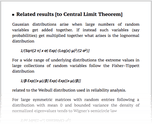
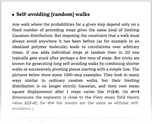
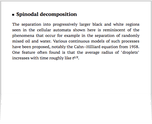
Basic aggregation model Central Limit Theorem [Circularity in] code 746 [Circularity in] other rules Diffusion-limited aggregation (DLA) Discreteness in computer programs Domains [in code 976] Generalized aggregation models History [of Central Limit Theorem] Implementation [of basic aggregation model] Isotropy [in lattice systems] Random walks Related results [to Central Limit Theorem] Self-avoiding [random] walks Spinodal decomposition
Section 7: Origins of Discreteness

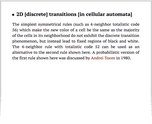
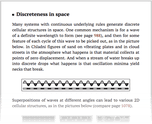
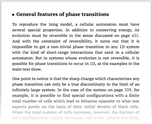
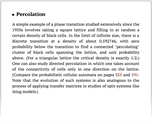
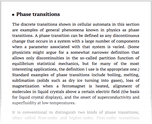
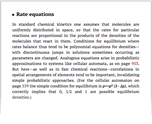
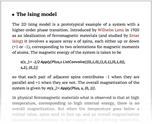
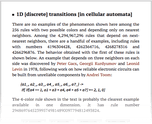
1D [discrete] transitions [in cellular automata] 2D [discrete] transitions [in cellular automata] Discreteness in space General features of phase transitions Percolation Phase transitions Rate equations The Ising model
Section 8: The Problem of Satisfying Constraints

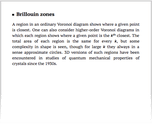
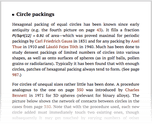
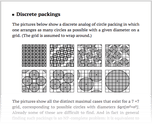
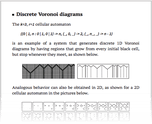
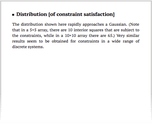
Biologically motivated schemes [for combinatorial optimization] Brillouin zones Circle packings Combinatorial optimization Discrete packings Discrete Voronoi diagrams Distribution [of constraint satisfaction] Gradient descent [in constraint satisfaction] History [of combinatorial optimization] Implementation [of constraint satisfaction] [Invariance examples in] 2D cellular automata Iterative improvement [of constraint satisfaction] NP completeness [and constraint satisfaction] Packing deformable objects Protein folding Rules versus constraints Sphere packings [Sphere packings in] higher dimensions Voronoi diagrams
Section 9: Origins of Simple Behavior

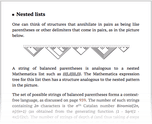
Examples of nesting Nested lists Nesting in numbers [Nesting in] phase transitions [Nesting in] random walks Origins of localized structures [Overall] structure of algorithms Previous approaches [to complexity] Repetition in continuous systems Repetition in numbers Self-organized criticality Uniformity in frequency

From Stephen Wolfram: A New Kind of Science [citation]