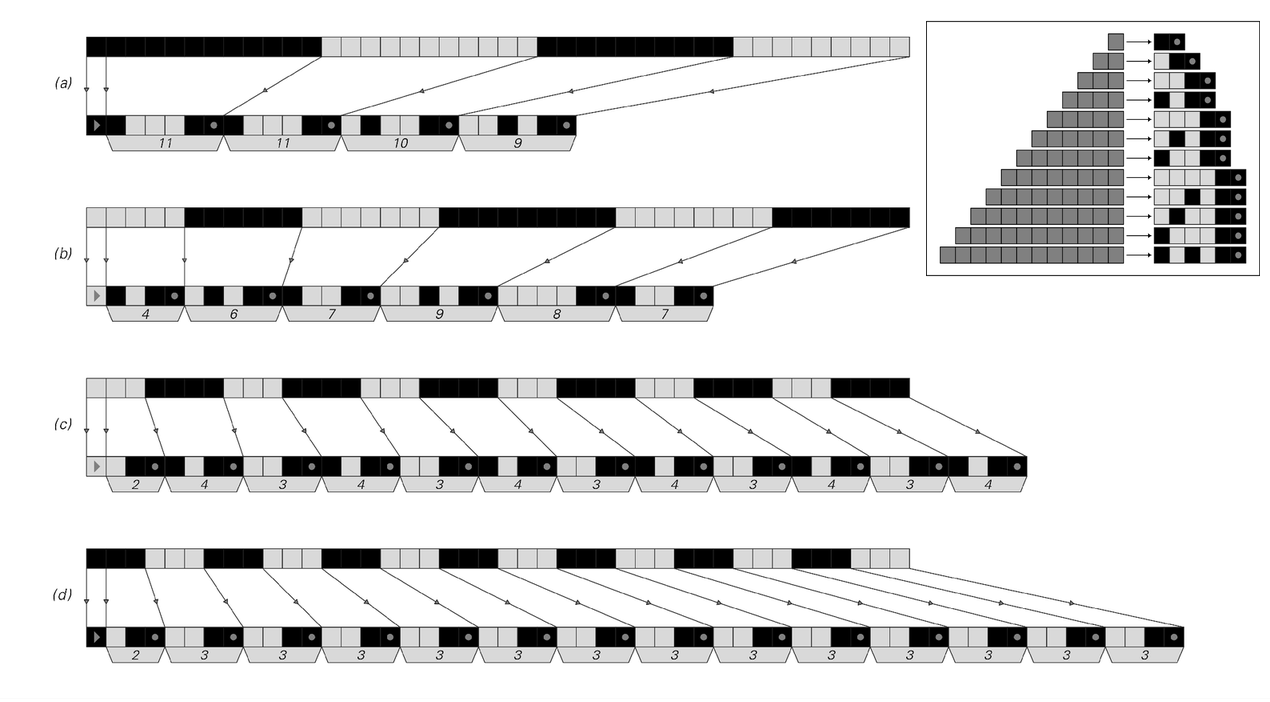
Indeed, any digit sequence can be thought of as providing a short representation for a number. But for run-length encoding it turns out that ordinary base 2 digit sequences do not quite work. For if the numbers corresponding to the lengths of successive runs are given one after another then there is no way to tell where the digits of one number end and the next begin.
Several approaches can be used, however, to avoid this problem. One, illustrated in picture (c) at the bottom of the facing page, is to insert at the beginning of each number a specification of how many digits the number contains. Another approach, illustrated in picture (d), is in effect to have two cells representing each digit, and then to indicate the end of the number by a pair of black cells. A variant on this approach, illustrated in picture (e), uses a non-integer base in which pairs of black cells can occur only at the end of a number.