

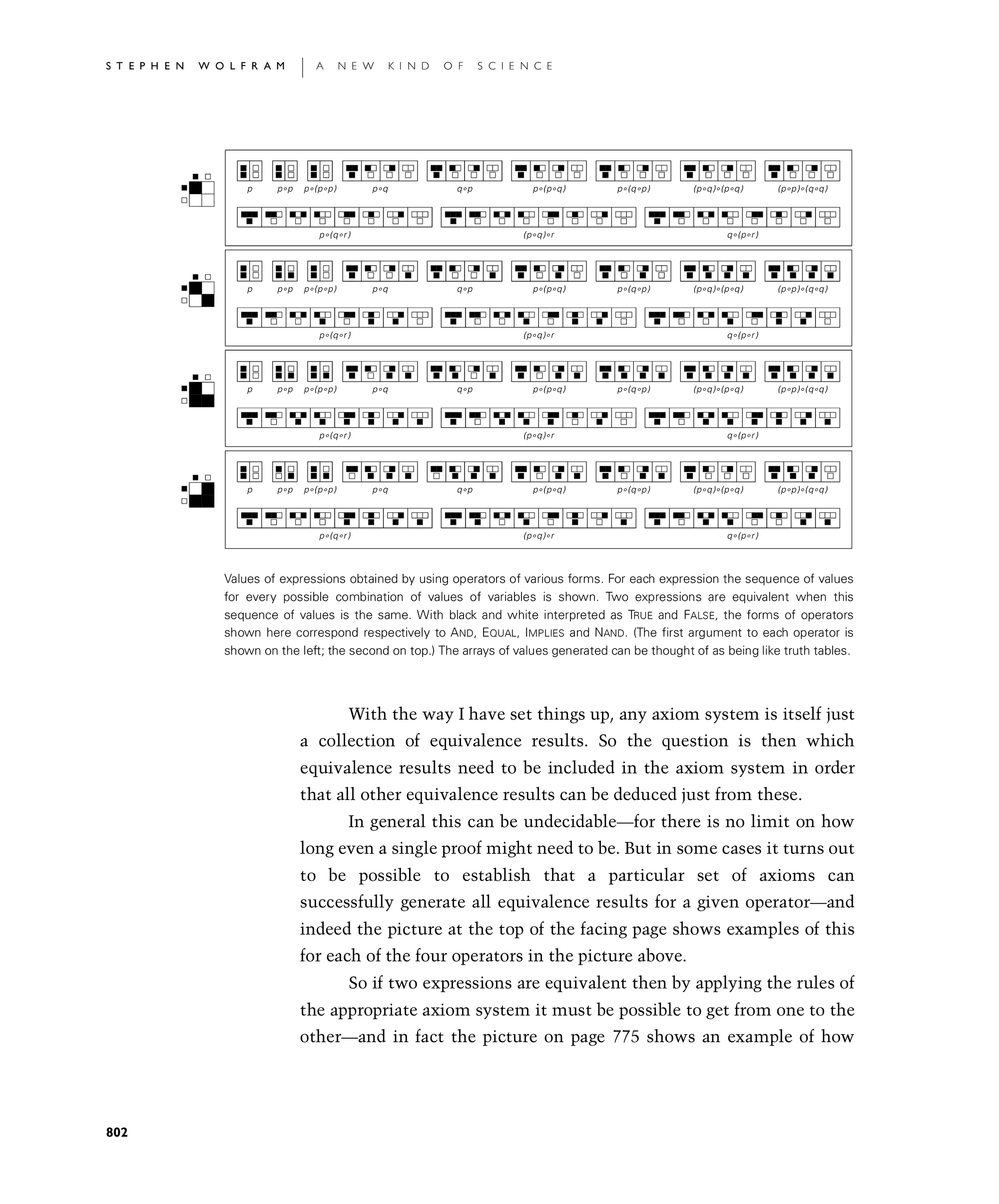
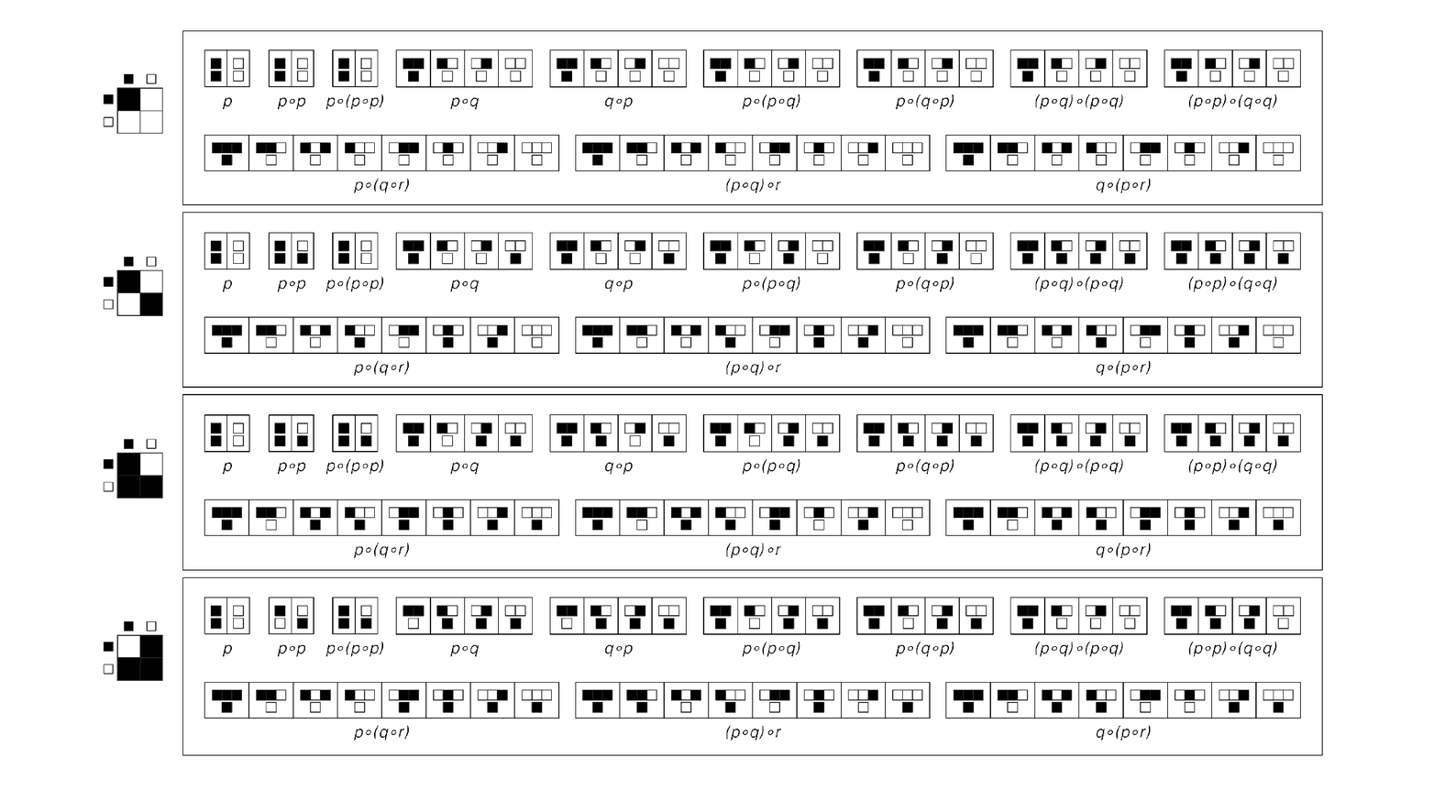
With the way I have set things up, any axiom system is itself just a collection of equivalence results. So the question is then which equivalence results need to be included in the axiom system in order that all other equivalence results can be deduced just from these.
In general this can be undecidable—for there is no limit on how long even a single proof might need to be. But in some cases it turns out to be possible to establish that a particular set of axioms can successfully generate all equivalence results for a given operator—and indeed the picture at the top of the facing page shows examples of this for each of the four operators in the picture below.
So if two expressions are equivalent then by applying the rules of the appropriate axiom system it must be possible to get from one to the other—and in fact the picture on page 775 shows an example of how