Notes

Chapter 4: Systems Based on Numbers


Section 1: The Notion of Numbers

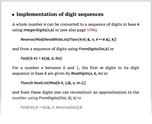
A note for mathematicians [about numbers] Gray code History of digit sequences History of numbers Implementation of digit sequences

Section 2: Elementary Arithmetic

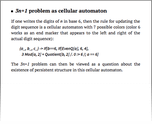
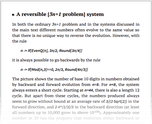
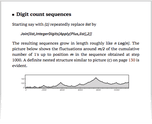
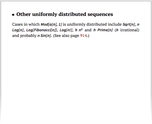
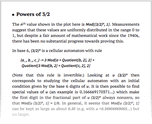
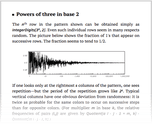
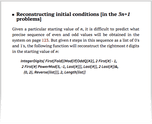
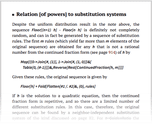
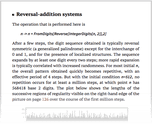
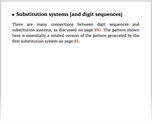
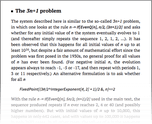
3n+1 problem as cellular automaton A reversible [3n+1 problem] system Digit count sequences Digit counts Digit reversal General powers [of numbers] History [of reversal-addition systems] Implementation [of 3/2 system] Iterated bitwise operations Iterated run-length encoding Leading digits [in numbers] Multiples of irrational numbers Multiplicative digit sequences Negative bases Non-power bases Other uniformly distributed sequences Powers of 3/2 Powers of three in base 2 Reconstructing initial conditions [in the 3n+1 problems] Relation [of powers] to substitution systems Reversal-addition systems Substitution systems [and digit sequences] The 3n+1 problem
Section 3: Recursive Sequences

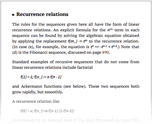
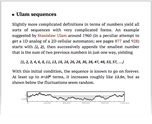
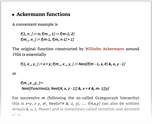
Ackermann functions Computation of [recursive] sequences History [of recursive sequences] Primitive recursive functions Properties of [recursive] sequences Recurrence relations Ulam sequences
Section 4: The Sequence of Primes

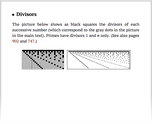
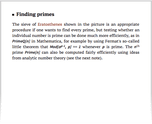
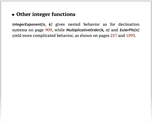
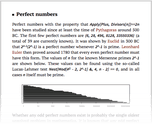
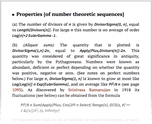
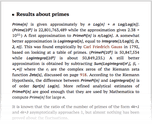
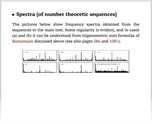
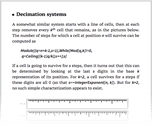
Decimation systems Divisors Finding primes History of number theory History of primes Iterated aliquot sums Numbers of primes Other integer functions Perfect numbers Properties [of number theoretic sequences] Relative primes Results about primes Spectra [of number theoretic sequences] Tables of primes Trapezoidal primes
Section 5: Mathematical Constants

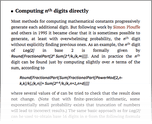
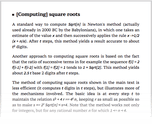
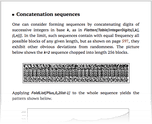
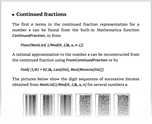
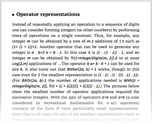
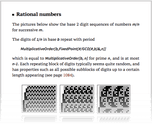
Computing nth digits directly [Computing] square roots Concatenation sequences Continued fractions Digit sequence properties Digital slope representation Digits of pi Egyptian fractions History [of continued fractions] Leading digits [in numbers] Nested digit sequences Nested radicals Number classification Operator representations Rational numbers Representations for integers Runs of digits [in numbers] Specially constructed transcendental numbers
Section 6: Mathematical Functions

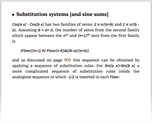
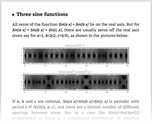
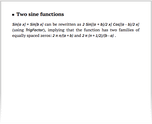
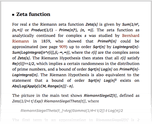
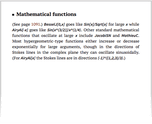
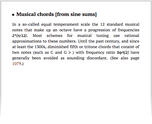
Differential equations [for sine sums] FM synthesis Lissajous figures Many sine functions Mathematical functions Musical chords [from sine sums] Substitution systems [and sine sums] Three sine functions Two sine functions Zeta function
Section 7: Iterated Maps and the Chaos Phenomenon

Chaos in nature Distribution of chaotic behavior Exact iterates [in iterated maps] Higher-dimensional generalizations [of iterated maps] History of chaos theory History of iterated maps Information content of initial conditions [Iterated maps from] bitwise operations Lyapunov exponents Mathematical perspectives [on iterated map complexity] Problems with computer experiments [in chaos theory] Smooth iterated maps
Section 8: Continuous Cellular Automata

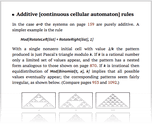
Additive [continuous cellular automaton] rules History [of continuous cellular automata] Implementation [of continuous cellular automata] Probabilistic cellular automata Properties [of addition continuous cellular automata]
Section 9: Partial Differential Equations

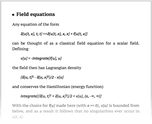
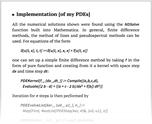
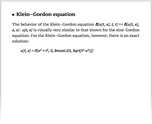
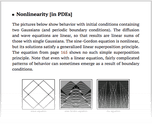
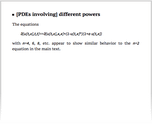
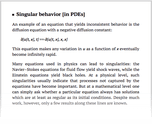
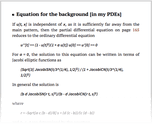
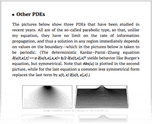
Equation for the background [in my PDEs] Existence and uniqueness [in PDEs] Field equations Implementation [of my PDEs] Klein–Gordon equation Nonlinearity [in PDEs] Numerical analysis [of PDEs] Ordinary differential equations Origins of the [partial differential] equations Other PDEs [PDEs in] higher dimensions [PDEs involving] different powers Singular behavior [in PDEs]
Section 10: Continuous Versus Discrete Systems

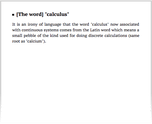
History [of continuous versus discrete mathematics] [The word]

From Stephen Wolfram: A New Kind of Science [citation]