

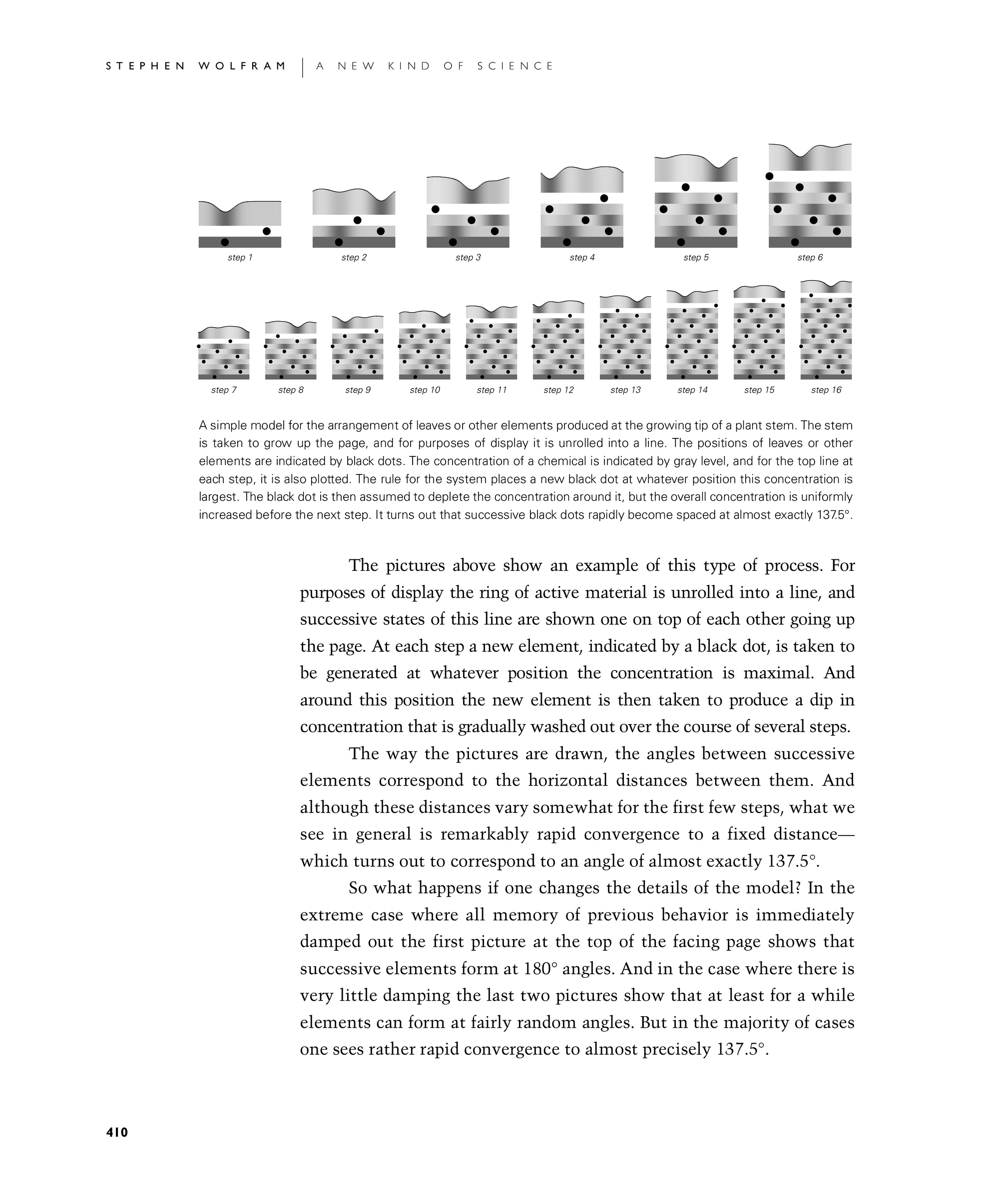
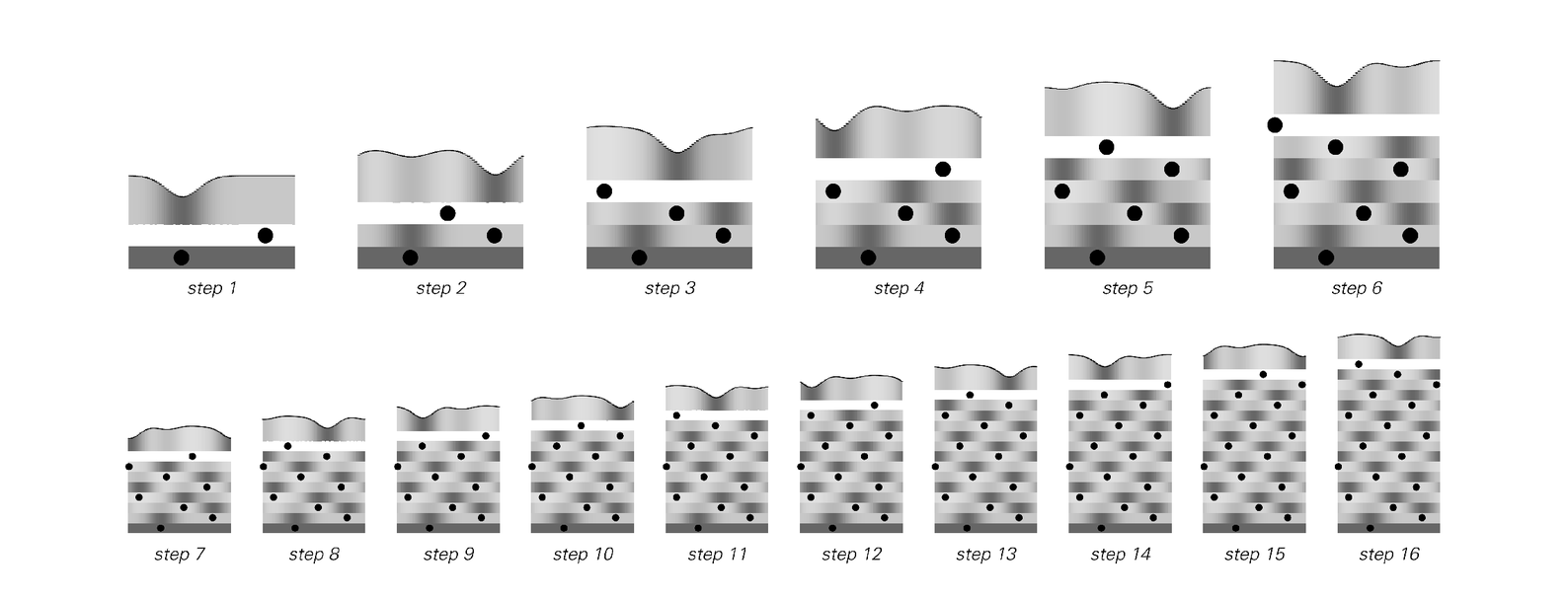
The pictures below show an example of this type of process. For purposes of display the ring of active material is unrolled into a line, and successive states of this line are shown one on top of each other going up the page. At each step a new element, indicated by a black dot, is taken to be generated at whatever position the concentration is maximal. And around this position the new element is then taken to produce a dip in concentration that is gradually washed out over the course of several steps.
The way the pictures are drawn, the angles between successive elements correspond to the horizontal distances between them. And although these distances vary somewhat for the first few steps, what we see in general is remarkably rapid convergence to a fixed distance—which turns out to correspond to an angle of almost exactly 137.5°.
So what happens if one changes the details of the model? In the extreme case where all memory of previous behavior is immediately damped out the first picture at the top of the facing page shows that successive elements form at 180° angles. And in the case where there is very little damping the last two pictures show that at least for a while elements can form at fairly random angles. But in the majority of cases one sees rather rapid convergence to almost precisely 137.5°.