

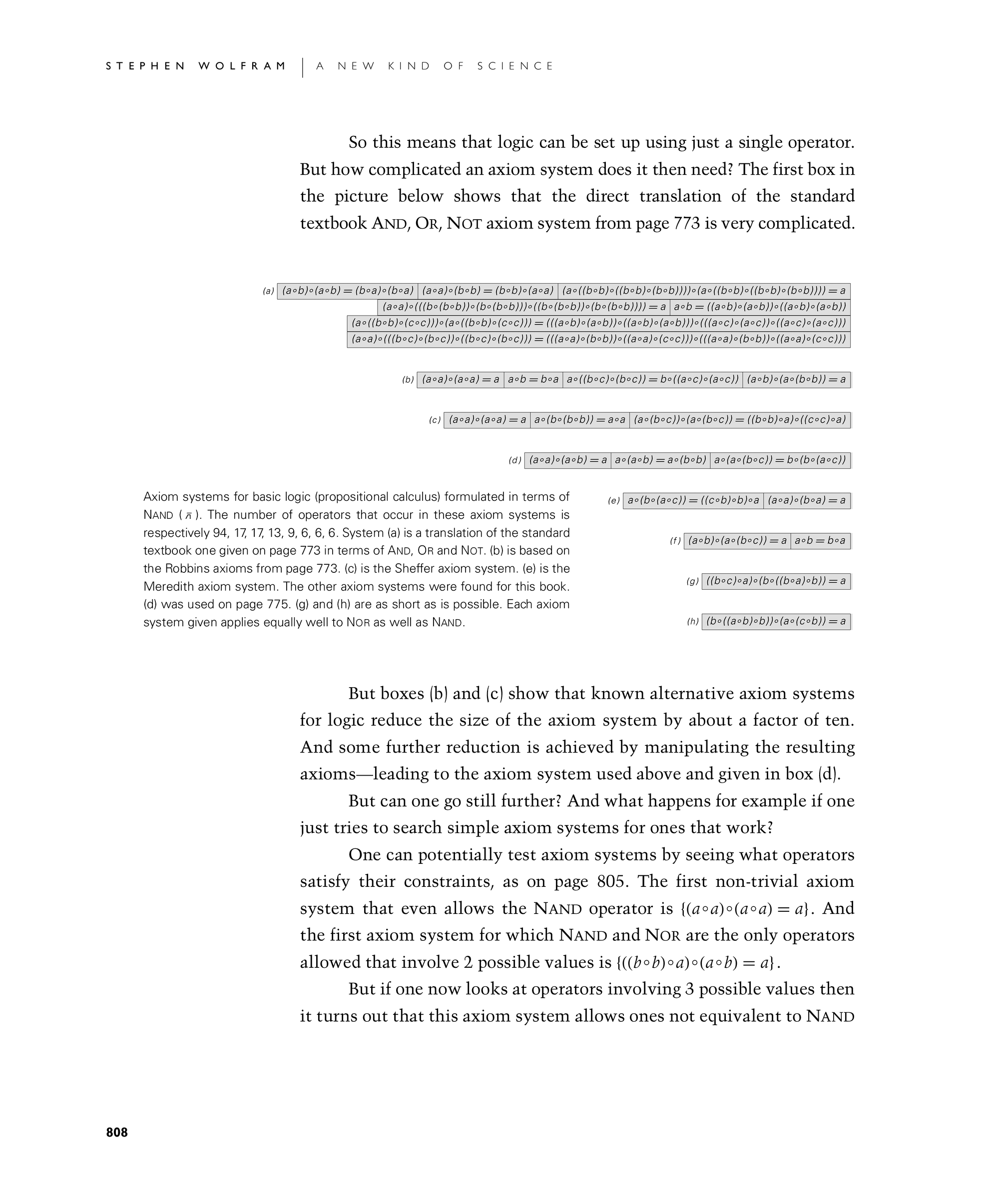
So this means that logic can be set up using just a single operator. But how complicated an axiom system does it then need? The first box in the picture below shows that the direct translation of the standard textbook And, Or, Not axiom system from page 773 is very complicated.
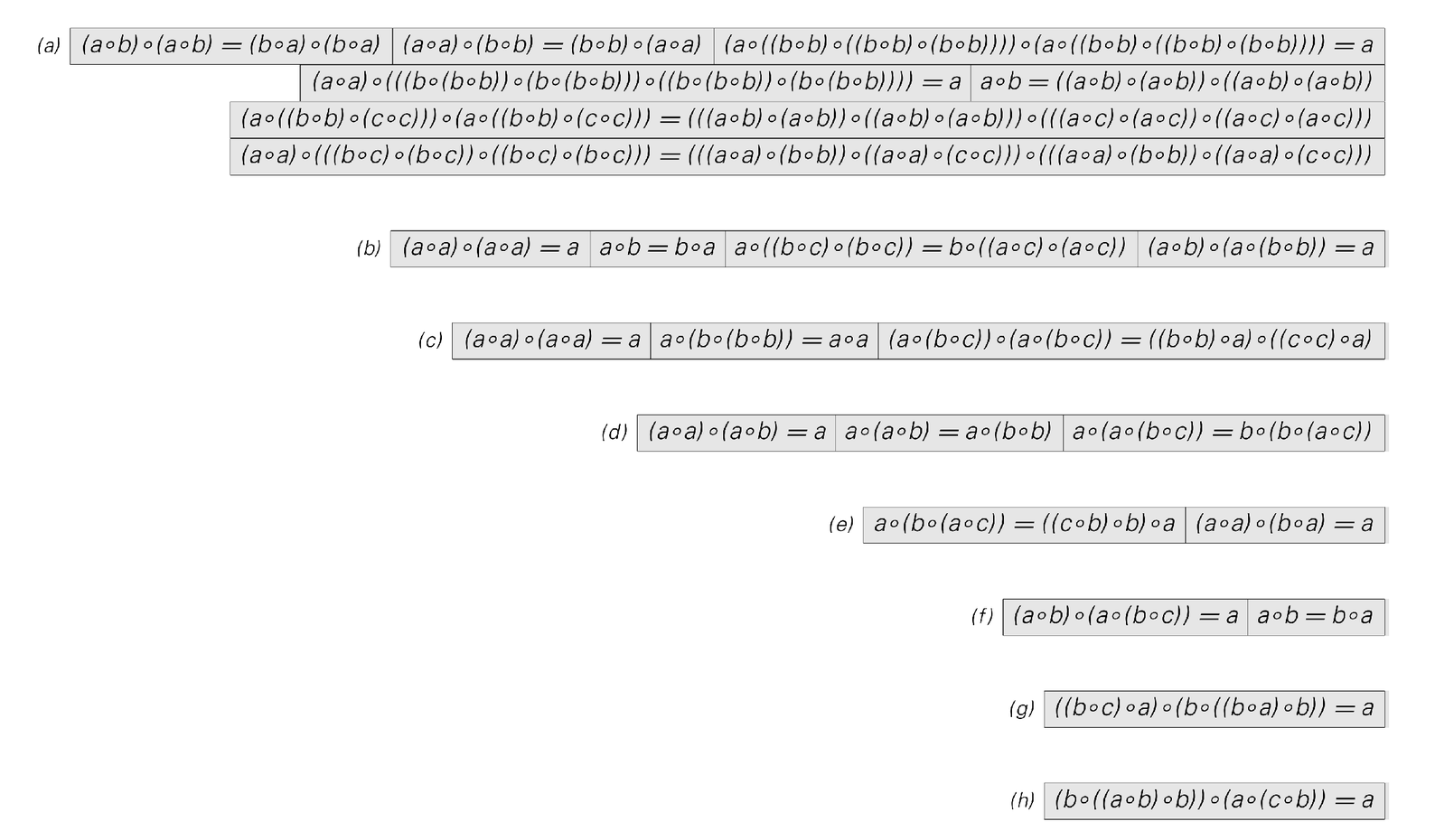
But boxes (b) and (c) show that known alternative axiom systems for logic reduce the size of the axiom system by about a factor of ten. And some further reduction is achieved by manipulating the resulting axioms—leading to the axiom system used above and given in box (d).
But can one go still further? And what happens for example if one just tries to search simple axiom systems for ones that work?
One can potentially test axiom systems by seeing what operators satisfy their constraints, as on page 805. The first non-trivial axiom system that even allows the Nand operator is {(a ∘ a) ∘ (a ∘ a) a}. And the first axiom system for which Nand and Nor are the only operators allowed that involve 2 possible values is {((b ∘ b) ∘ a) ∘ (a ∘ b) a}.
But if one now looks at operators involving 3 possible values then it turns out that this axiom system allows ones not equivalent to Nand
